Get info
PII :Workshop Buriram
Date : 2025-09-04
Venue : Queen Sirikit Sericulture Center (Buriram). Phutthaisong, Phutthaisong District, Buriram
Agenda
- Scale-up
Phase
2nd Climate Change Adaptation Planning
and Technologies Workshop
-----------------------------------------------------------------------------------
Climate Smart Farmer Model for Mulberry Silk Cultivation
in Northeastern Thailand
--------------------------------------------------------
-Introduction-
Climate-Resilient Sericulture: Empowering Women Farmers in
Buriram and Chaiyaphum
Thailand has been ranked 9th in the world for its long-term
climate risk, according to the GermanWatch Global Climate Risk Index 2021. The
agricultural sector is the most vulnerable in terms of the economy. The
Northeast, in particular, face severe drought in every six-year period, coupled
with flood in rainy season and heat-stress in dry season. The most effected
provinces are Nakhon Ratchasrima, Khon Khen, Buriram, Surin, Roi Et, Si Sa Ket,
Ubon Ratchatani. These are the provinces that compose over 90 per cent of all
the farmers in sericulture sector of the country. Mulberry silk cultivation is
a lifeline supplementary occupation of Thailand’s rural poor farmers, who live
below the poverty line of less than $ 5 per day. Therefore, the target
population of this proposed project will be 10,000 mulberry silk farmers,
covering some 2,800 acres of mulberry tree plantation fields in the Northeast
of Thailand. These farmers have no or very little knowledge about climate risks
in their areas. They had little or even zero income when hit by a disaster. For
example, the flood in 2023 prompted some of them to lose their lifeline and
turned to use their labour for minimum wage income, or became street vendors,
to sustain their families. Consequently, Thailand is losing more and more
mulberry silk farmers, thus, putting sericulture, the Thai century-old cultural
heritage, at risk of extinction.
The following is an estimate data for sericulture in
Thailand.
· Total mulberry
sericulture area (2013): ~55,090 rai
(~8,816 acres)
· Northeast region
(≈80 %): ~84,885 rai (~13,594 acres)
· Buriram +
Chaiyaphum + Nakon Ratchasima likely cover 20,000–30,000 rai (~3,200–4,800 acres)
Communities in Thailand’s
northeastern provinces, including Buriram and Chaiyaphum, have long struggled
with poverty exacerbated by chronic drought and seasonal flooding. These
climatic challenges have intensified due to climate change, severely impacting
rural livelihoods—particularly in traditional mulberry silk farming communities
where sericulture remains a cultural and economic lifeline.
In the three provinces, silk mulberry cultivation has been
practiced for generations, rooted in local wisdom passed down through families.
However, farmers in these areas have faced increasingly unpredictable weather,
leading to crop failure, silkworm mortality, and disruption across the silk
value chain. Villagers often find themselves with little to no income during
harsh seasons. Income disparities are wide: some farmers earn just above the
poverty line, others fall well below minimum wage, and many have no earnings at
all during years of severe flood or drought.
This project proposes a new, climate-resilient model of
sericulture tailored for these regions. It integrates local knowledge with
emerging technologies to help women sericulturists in Buriram and Chaiyaphum
adapt to climate impacts, improve productivity, and secure more stable incomes.
The proposed initiative will be a scaleup of the first of its kind in Thailand
to approach sericulture through a climate change adaptation lens under the
project’s phase I. It will introduce digital weather forecasting tools, promote
organic silk farming innovations, and support inclusive, gender-responsive
planning. A traditional soil preparation method known locally as “Khet Kam”
will also be reintroduced, improving soil resilience and crop yield.
Progress to date
Over the first seven months, about 670 men and women in the
target communities have been trained in digital tools for climate-smart
agriculture, marketing innovations, and inclusive project planning. They will
learn how to blend local techniques with modern climate solutions, such as
monitoring weather forecasts to reduce loss from future climate events.
Training will also include modules on C-to-C (consumer-to-consumer) online
marketing, helping farmers to reach wider markets and earn fairer prices for
their silk.
Within a year, the project will document the process of
women’s leadership in transforming traditional sericulture into a smart,
climate-adaptive enterprise. Farmers will emerge as “smart farmers”—capable of
using technology and local knowledge to navigate climate risks, plan their
farming activities with a gender lens, and secure long-term sustainability for
their families and communities.
This initiative represents a scalable, innovative model for
rural adaptation in Thailand, and has the potential to inspire similar
transformations in other silk-producing provinces across the region.
Target group and area covered
Our target group comprises women sericulturists in
traditional mulberry silk farming communities across Buriram, Chaiyaphum, and
Nakhon Ratchasima. These provinces, known for their rich silk heritage, have
suffered increasingly from the impacts of flood and drought, which have
devastated silk mulberry crops and disrupted rural livelihoods. Many villagers
are now struggling with near-zero income, especially in the off-season and
during extreme weather events.
The proposed business model will empower these communities
by combining local wisdom—such as the use of silk floss residue as organic
fertilizer—with modern weather forecasting technologies and climate-smart
farming approaches. A central focus of the initiative will be to promote and
strengthen the roles of women in climate change adaptation, recognizing their
leadership in child-rearing, household management, and preservation of cultural
practices such as silk weaving and mulberry cultivation.
The project is expected to directly benefit 620 men and 840
women. They will gain indirectly through extended community engagement and
training dissemination. In total, the initiative will benefit approximately
2,240 villagers across selected subdistricts in the three provinces. The
program will represent diverse communities, including representatives from
multiple sub-villages, and is estimated to cover activities across more than
4,000 acres of mulberry cultivation and associated farmland.
Mulberry farming innovation and technology for climate
change adaptation
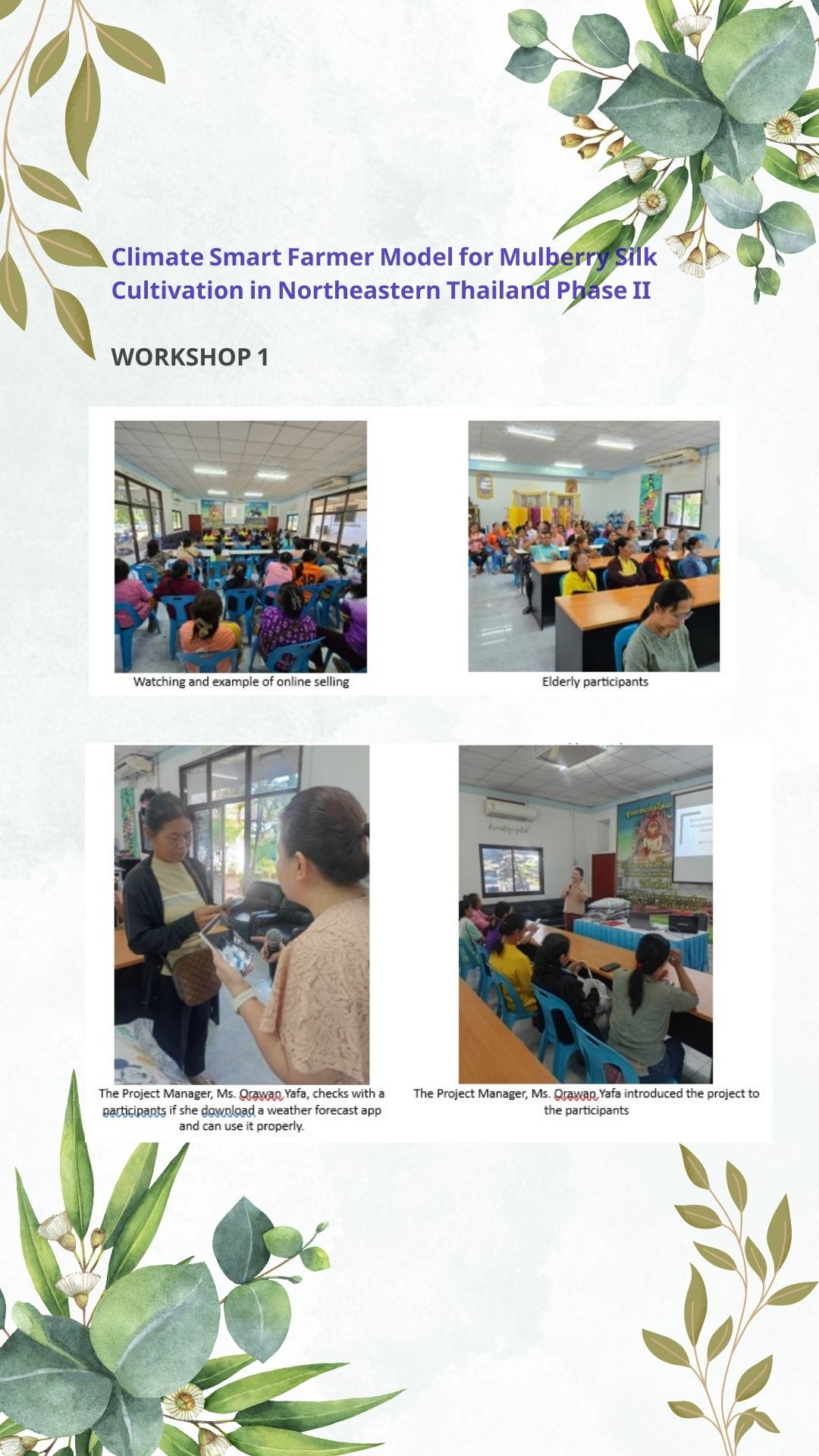
Upon a welcome remark by the Director of Buriram, Chaiyaphum
and Nakon Ratchasima Sericulture Center, the project manager introduced the
participants to the project followed by an introduction to climate risk
information.
Introduction to "Fah Fon" Application and other
five climate resilient innovation
Once the participants were familiarized with basic
information on climate change, its impact, and how to mitigate the impacts. The
project manager, the Director of Buriram, Chaiyaphum and Nakon Ratchasima
Sericulture Centre, and the showed examples of farming innovations from around
the world to the participants, so that they can relate to innovations which are
likely to be useful and practical for them.
Introduction to gender inclusiveness in climate change
adaptation plan
Ms. Orawan Yafa introduced the concept of gender
inclusiveness to the participants and showed them basic vocabularies. She
encouraged the participants to adopt the idea to their respective communities’
climate change adaptation plan.
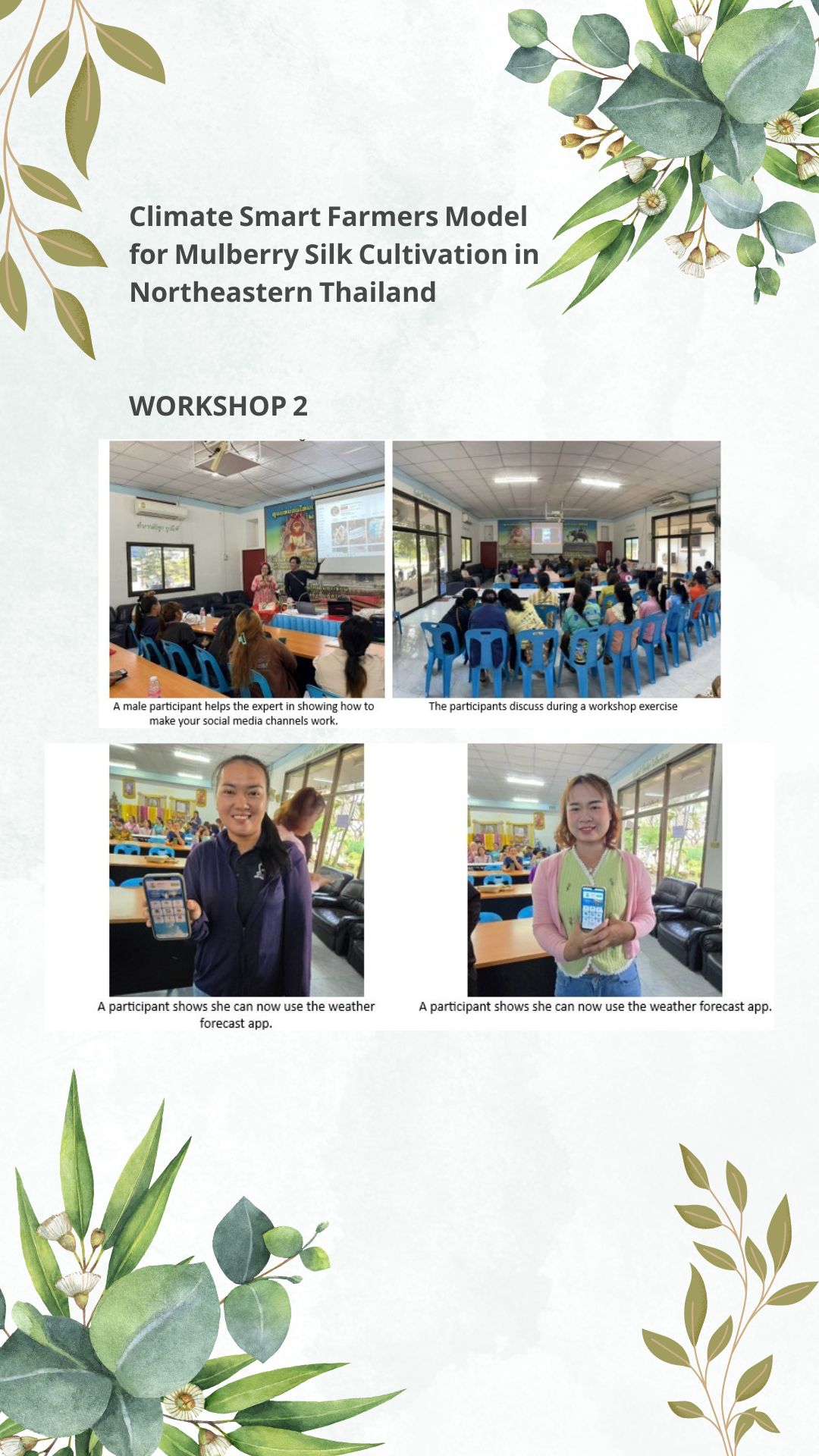
Introduction to social media and online marketing
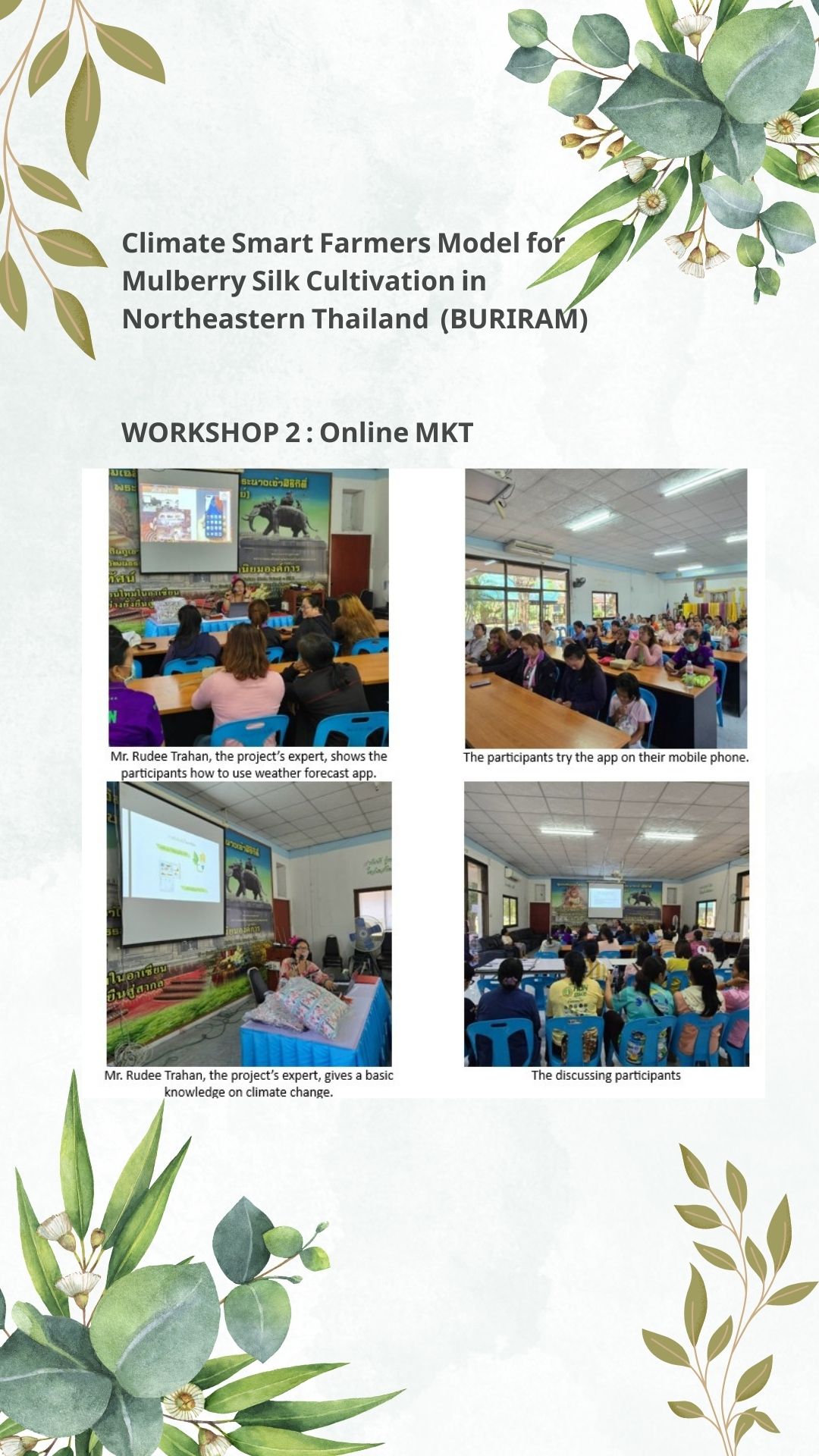
The project invited Ms. Rudee Tahan, a social marketing expert with over 15
years of experience at national level, to show the participants how, by using
AI-generated contents, the social media
and online marketing can work its magic and create both
traditional and financial values to their products. She demonstrated the best
practices from across the country and outside. The participants were very much
inspired by the presentation.
Introduction to soil preparation technique by Tambon
Agriculture Officer
Selecting an area
Mulberry is a plant that can grow well in almost every type
of soil. But growing mulberry to produce mulberry fruit requires taking into
account many different factors as follows:
· It must be an
area that has not been flooded or flooded for a long period of time, has good
drainage and has a deep soil surface.
· The soil is not
acidic, or too alkaline. Soil pH should be between 6.0 – 6.5.
· Conditions: The
ground must be an area that has no history of an outbreak of mulberry root rot
disease, if there ever was one This history must be resolved by planting
using durable rootstock against root rot disease.
· There is a water
source that can provide water during the period. See if it rains during the
rainy season or during the dry season, especially during January until April.
The mulberry trees are in the process of flowering and harvesting, which will
greatly affect the yield of the mulberry fruit.
· Convenient
transportation area, able to work easily and transport mulberry products
easily.
· Not too far from
the market and the mulberry fruit processing industry. This is because
mulberry fruits are easily damaged if transported periodically long and distant.
Soil
preparation techniques
After selecting the area suitable for making a mulberry
garden, fences should be put up to prevent animals from destroying the mulberry
plot, such as cows, buffaloes, etc. And, before planting mulberries, do the
following:
1. Double tillage: Plow
the soil to turn the bottom layer of soil up to the top layer. Then dry it in
the sun for 2-3 days, then plow and
turn the soil again to treat pests and various germs in the soil. and to
eliminate weeds
2. Cement ring: Plow to make the soil loose and
suitable for growth.
3. Add organic fertilizers such
as manure, compost, green manure, approximately 1,200 kilograms per rai, and
chemical fertilizers to increase organic matter in the soil and to improve soil
characteristics, then plow and cover.
4. Estimate the appropriate
planting distance to prepare for planting.
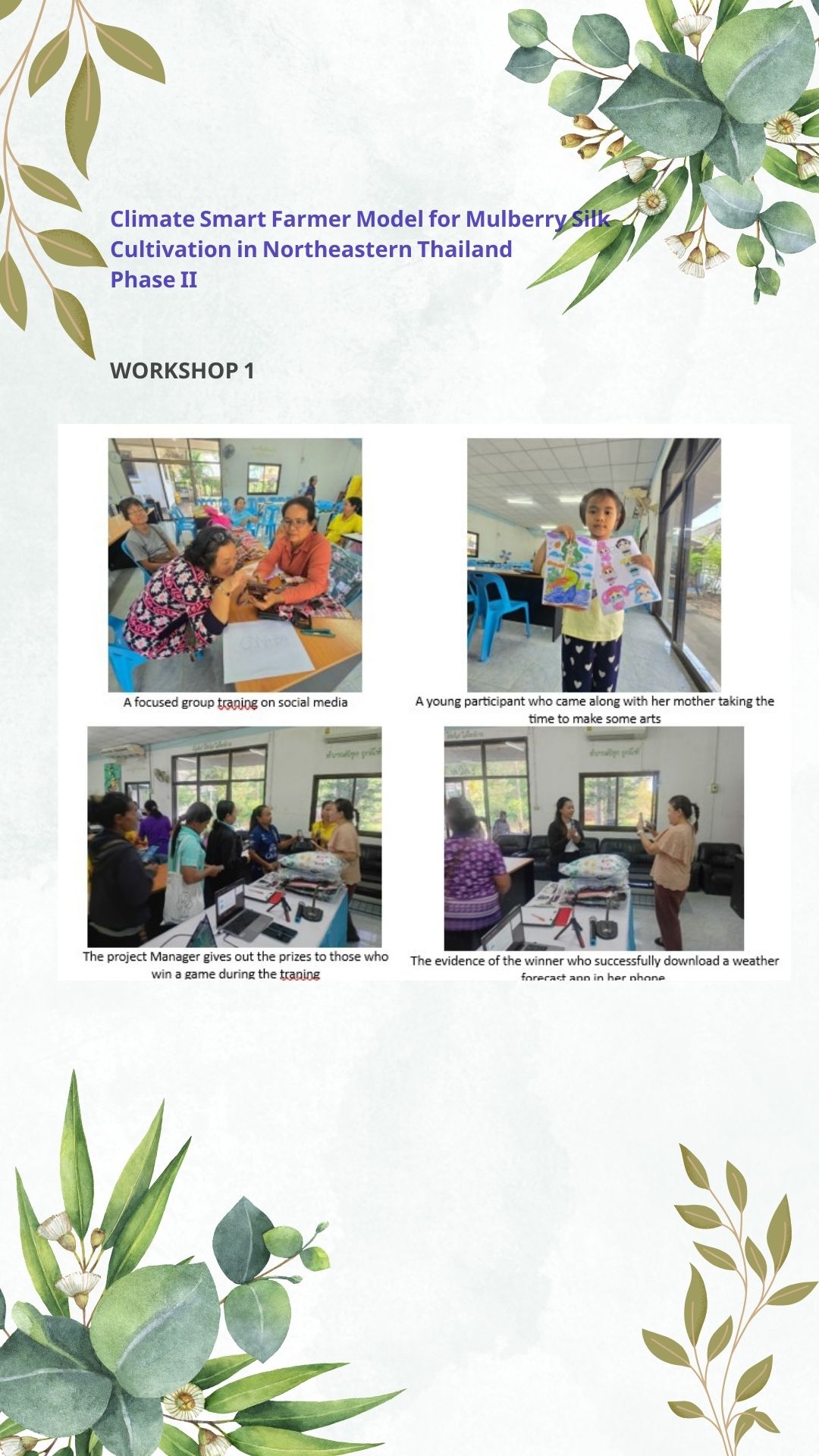
Upon conclusion of the day, about 60 people volunteered to
be a focused group for additional training in social media and online
marketing.